
What you need to know
- A follower is not a customer waiting to happen. A person can like your posts for months without ever understanding what you sell, why it is different, what it costs or what they should do next. That is why follower growth and sales can move in completely different directions.
- Instagram has every reason to keep a user watching, scrolling and interacting inside Instagram. Your business has a different objective: move the right person from discovery into a relationship you can continue. Those incentives are not identical.
- First, relying on a generic link in bio. It asks the visitor to remember why they were interested, leave the content, navigate to the profile, choose from several links and then re-orient themselves on another page. Every extra decision can lose momentum.
The gap between attention and a sale
A follower is not a customer waiting to happen. A person can like your posts for months without ever understanding what you sell, why it is different, what it costs or what they should do next. That is why follower growth and sales can move in completely different directions.
The useful diagnosis starts after engagement. Someone sees a post and feels interested. What happens next? Do they know whether to comment, send a DM, open your profile, click a link, join a list, book a call or buy? If the next step is vague, the moment of interest disappears into the feed.
This is the central problem behind many accounts that look healthy from the outside: the content creates attention, but there is no dependable mechanism for capturing and continuing that attention.
Instagram is built for continued consumption
Instagram has every reason to keep a user watching, scrolling and interacting inside Instagram. Your business has a different objective: move the right person from discovery into a relationship you can continue. Those incentives are not identical.
That does not make Instagram bad for business. It means a post cannot be expected to do every job. Discovery content can earn attention. Proof can reduce doubt. A direct message can answer a question. A landing page can capture contact details. Email or WhatsApp can continue the conversation. A checkout or booking flow can close it.
When one post is expected to discover, educate, persuade and close a stranger in a single step, the problem is often the journey design rather than the content quality.
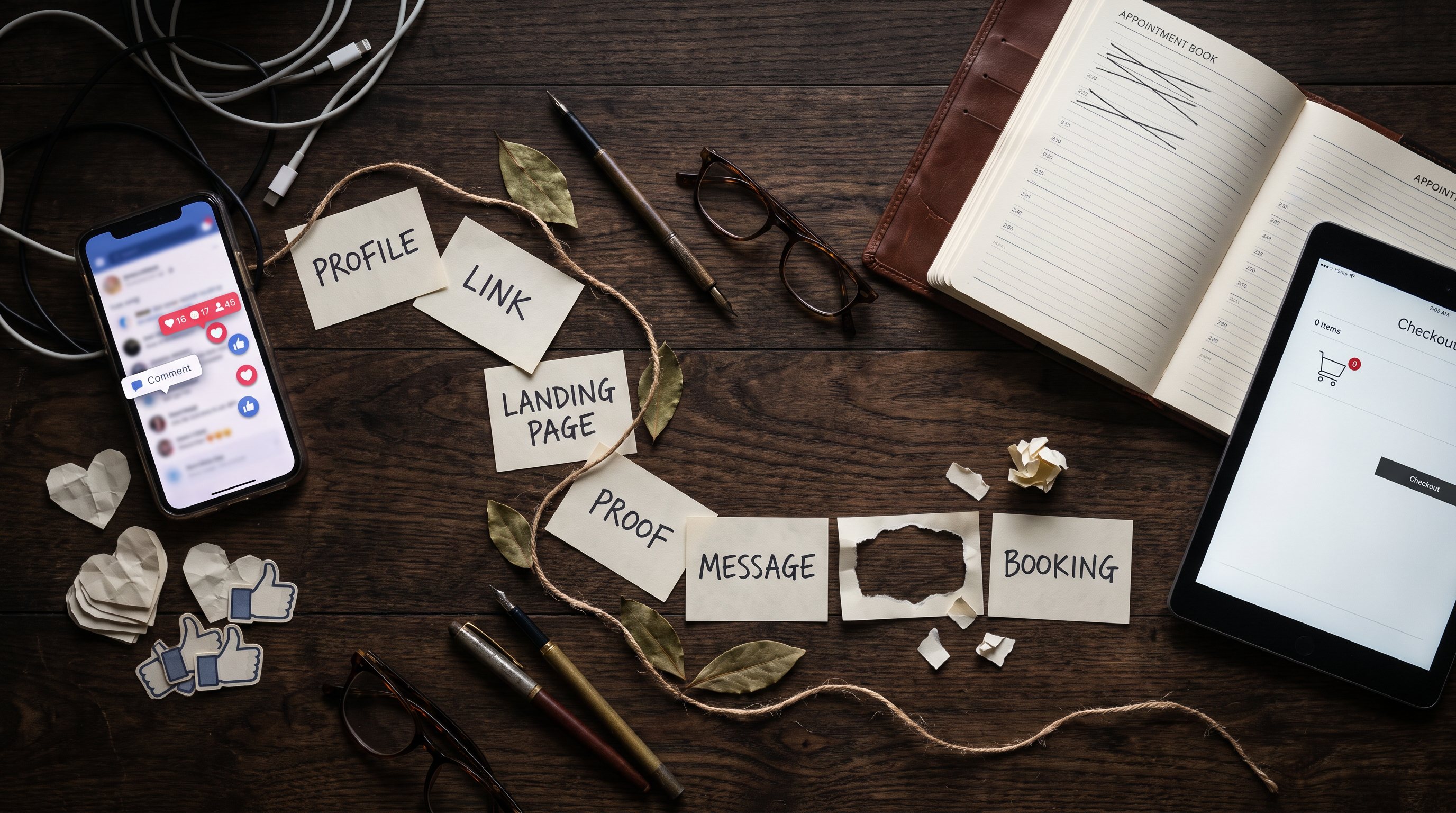
Three common mistakes that kill the journey
First, relying on a generic link in bio. It asks the visitor to remember why they were interested, leave the content, navigate to the profile, choose from several links and then re-orient themselves on another page. Every extra decision can lose momentum.
Second, publishing without a capture mechanism. A useful post can generate comments, saves and profile visits while leaving the business with no way to continue the relationship. A relevant DM keyword, focused landing page, newsletter, WhatsApp conversation or other permission-based next step can preserve intent.
Third, treating every follower like a direct buyer. Many people need repeated exposure, proof and answers before they purchase. The system should make that progression easy instead of demanding a checkout from everyone immediately.
What a simple conversion system looks like
A practical flow can be surprisingly small: useful post → specific call to action → immediate response → focused page or conversation → permission to follow up → useful follow-up → offer. The exact channels matter less than continuity.
For a creator selling a digital product, the capture point might be a comment keyword that triggers a DM and leads to a simple opt-in page. For a salon, it might be a Reel that opens a prefilled WhatsApp conversation for the correct branch. For a consultant, it might be a post that leads to a focused case study and then a booking page.
The principle is the same: do not make an interested person reconstruct the journey from scratch.
Audit the hand-offs before posting more
Open Instagram as if you have never seen the business. Read the bio. Can you tell what is sold, who it is for and what to do next? Open the primary link. Does the next page continue the same promise? Try to contact the business. Is the message routed correctly? How quickly does a useful response arrive? Try the booking or checkout path on a phone.
Write down every hesitation and unnecessary choice. Fix the break closest to purchase first. If people are already messaging but nobody replies, a new content calendar is not the highest-priority solution. If profile visitors cannot tell what the business offers, more reach may simply send more people into confusion.
Measure the journey, not only the follower count
Track the sequence that matters: reach, profile actions, qualified clicks, conversations, captured leads, bookings and sales. Not every business needs sophisticated attribution on day one, but it should at least know whether increased attention is producing more high-intent actions.
Once those events are visible together, content becomes easier to judge. Some posts are excellent discovery assets even if they do not sell directly. Others may generate fewer likes but more qualified conversations. That distinction is much more useful than asking whether the account gained followers this week.